
Grist for Manufacturing
The custom manufacturing software that adapts to your unique product workflow.
Instead of forcing factory processes into rigid, out-of-the-box software, build the exact tools you need. From inventory tracking to production planning, combine the flexibility of a spreadsheet and the structure of a database. Open-source, self-hostable, and Python-powered.
Why settle for manufacturing software that doesn’t fit?
Spreadsheets are too fragile: You love the flexibility, but broken formulas, version conflicts, and data silos are costing you time. A standard spreadsheet can’t handle the complexity of bills of materials (BOMs) or multi-user inventory updates.
ERPs are too rigid: Traditional manufacturing ERPs are expensive, clunky, and force you to change your workflow to match their software. Customizing them requires expensive consultants and months of development.
The “low-code” sweet spot: Grist gives you the best of both. You get a relational database that ensures data integrity (like an ERP) with a familiar interface you can customize yourself (like a spreadsheet).
Build your production system, your way
Connect your data logic: Don’t duplicate data. Link your Raw Materials database directly to your Work Orders and Finished Goods. Update a cost in one place, and watch it ripple through every bill of materials instantly.
Design custom views for every team: Give the shop floor a simple “Check-in/Check-out” card view. Give the purchasing manager a high-level “Low Stock” dashboard. Build custom screens in minutes using drag-and-drop widgets (no IT team required).
Total control, no lock-in: Need complex logic? Use standard Python formulas to calculate waste percentages, lead times, or pricing tiers. Because Grist is open-source, you own your data and can even self-host for total security and compliance.
Make the most of your data



Features
Data superpowers
Streamline your work with Grist’s familar UI and modern feature set.
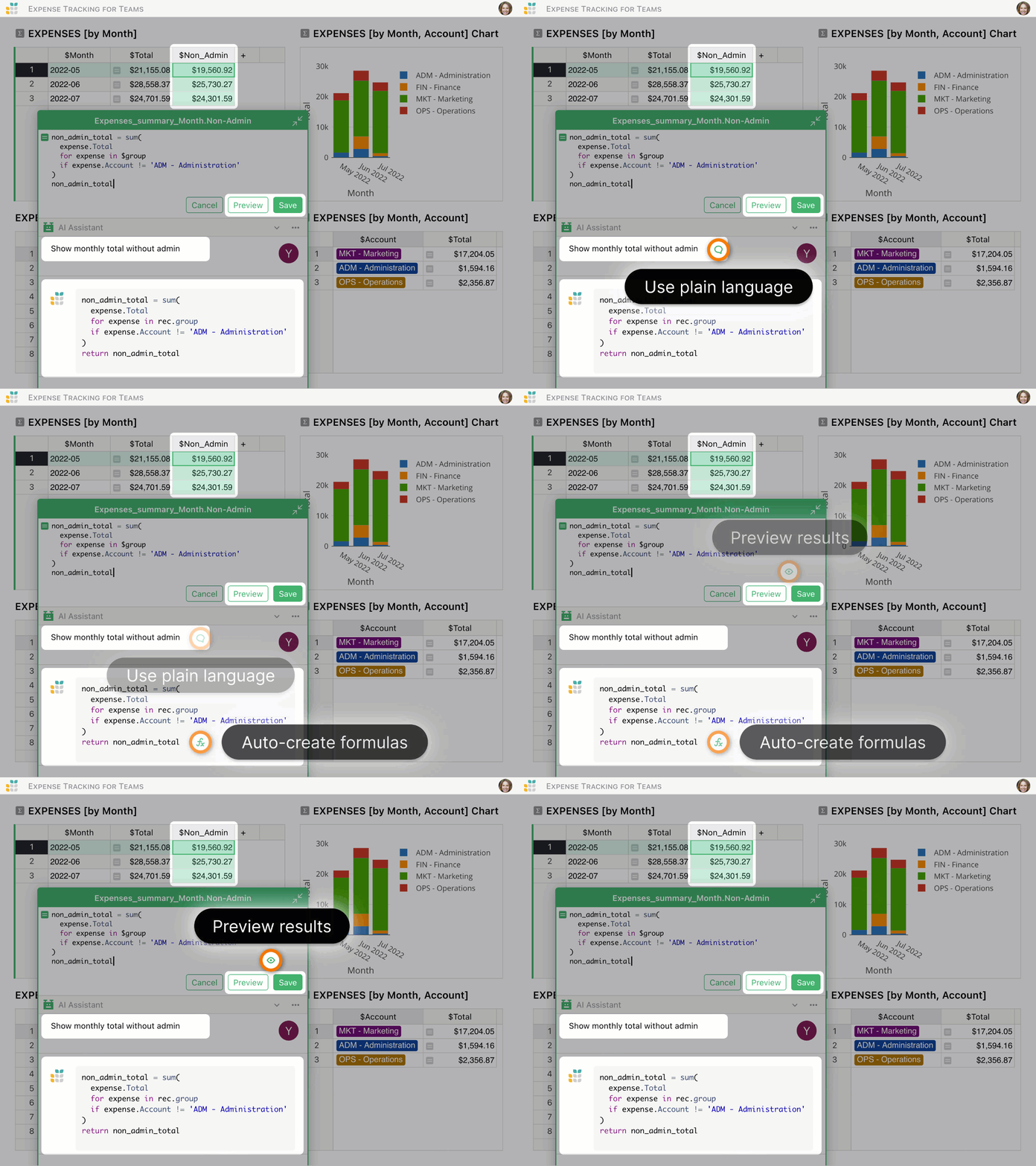
AI Assistant
The hardest part of working with spreadsheets made easy with AI.
- Create formulas using plain language.
- Leverage the power of Python without being an expert.
- Iterate on formulas using retained conversational context.
Flexible layout
Arrange your data on screen to maximize your and your team’s productivity.
- Drag-and-drop widgets to make custom layouts.
- Link data to quickly pull up details and related records.
- Turn rows into data cards, and attach relevant images and files.
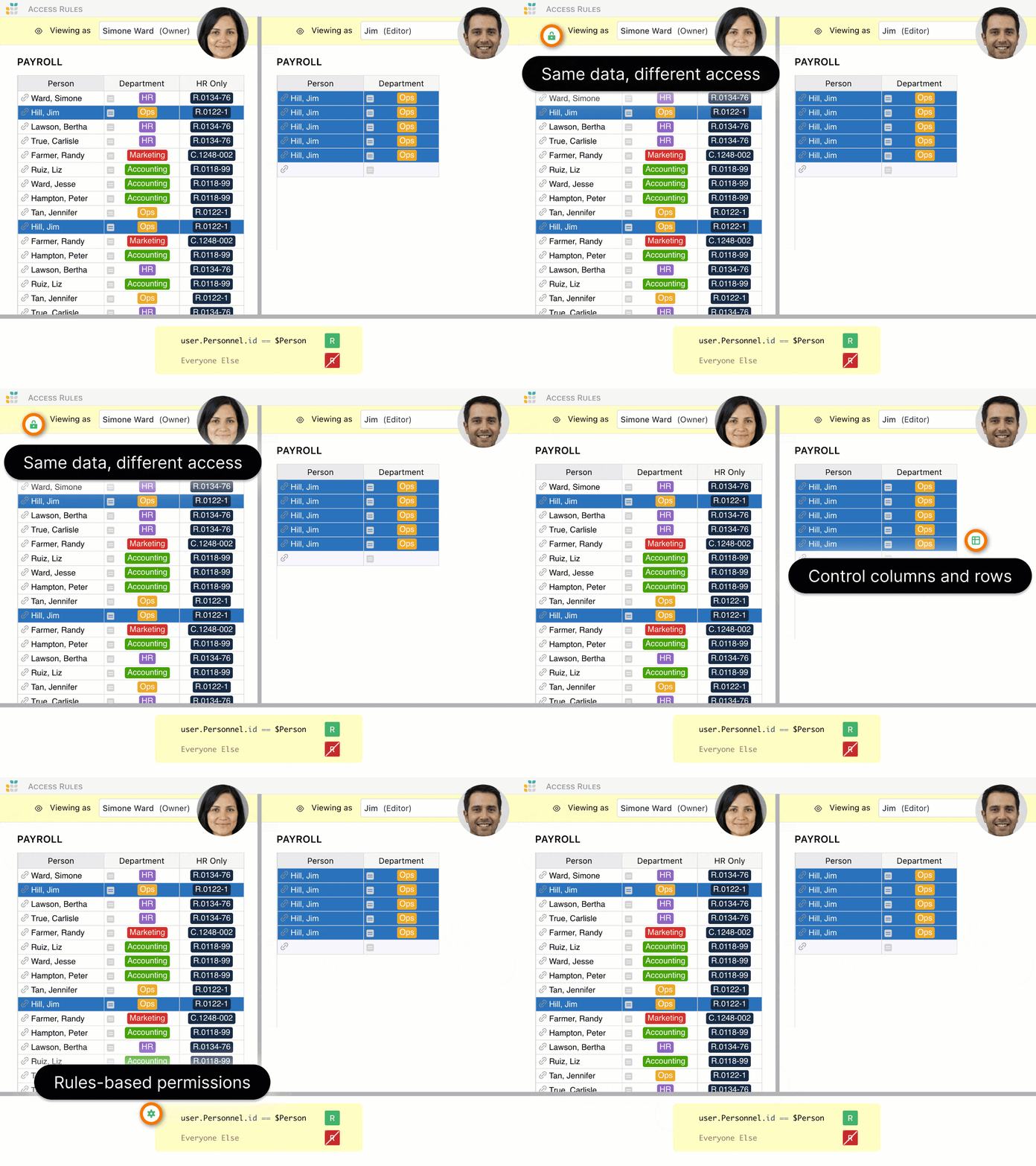
Access rules
Collaborate with confidence and peace of mind, using unique system of granular data permissions.
- Control who sees what, down to each row and column.
- Share data in part or in full, and still collaborate in real-time.
- Share limited views of relevant data with third parties.
Visualizations
See what matters at a glance, from big trends to small details.
- Summarize data into charts or pivot tables to see the big picture.
- Link charts to update dynamically to visualize segments of data.
- Show data in new ways with a gallery of custom widgets, or build your own.
More features
Streamline, control, and drill into your data. Discover the endless possibilities of our full-featured relational spreadsheet.
- Formulas with Excel functions and Python power.
- Automatic backups and snapshot history.
- Conditional styles, and cell formatting.
- Localized into 12 languages.
- APIs and integrations.
Professional Services
Grist Solutions
We’ll create a custom solution that makes your data more useful – now, and far in the future.
Plan your solution
Work with us to identify workflow pain points and improvements.
Customize based on your needs
We’ll create a solution that fits, and a solution that lasts.
Build with experts
Not just a custom solution, but expert advice from those closest to Grist.
Sign up now
Discover the better spreadsheet.
Full-featured free plan, data privacy, no lock-in.

Templates
Ready-to-use templates
Get a running start with many templates to choose from,
to use as is or customize to your needs.
Inventory Tracking Spreadsheet
Manage your inventory and track incoming and outgoing orders, all in one place.
View TemplateLightweight CRM Template
Manage customer info and interactions in a user-friendly, spreadsheet-style CRM template.
View TemplateDevelopers
Power tools
Take it to the next level with our open-source spreadsheet-database tool.
Super-charged formulas
- Fully supports Python syntax and standard library in formulas.
- Includes many familiar Excel functions.
Extensible
- Connect to anything via REST API, webhooks, or integrators.
- Create your own custom widgets.
Unprecedented control
- Can be self-managed, for intranet operation or compliance.
- Uses SQLite format, great for portability and backups.
“I love Grist. It’s crazy powerful. I still can’t believe what we’ve been able to achieve in it. It’s the dream that low-code was sold as for years – we can do incredible things in each column with Python and we can build our own widgets to run on those! Wild!”
Elliot Lee
User Researcher
“Grist has become our go-to for more complex, structured data. It sits somewhere between Excel and Access—powerful, relational, and flexible enough for prototyping real data-driven applications.”
Olivier Lambert
CEO at Vates
“The more I use Grist, the more I LOVE it. I have been surveying self-hosted database GUI tools, and I was consistently disappointed with their shortcomings or bugginess. Grist is the first to have tilted the balance the other way.”
Stephen S.
Publications, Personal City Guides
“Grist has given us incredible flexibility to solve data problems and find solutions, whether it is for a small team at the district, or at scale with the entire district staff. We’re really excited about the different ways we can use it going forward.”
Director of Product
EdTech Company
“What I like about Grist the most is its focus. It appears simple, but it’s very powerful in a focused way. Grist has really improved our workflow and communication.”

Chris Scott
Co-founder in Digital Marketing
“If people spend some time learning a new tool they’ll have more power to do their work and research. I said to one of my students, ‘You will be very very happy using Grist because you are miserable using Excel!'”

Eduardo Dalcin, Ph.D.
Biodiversity Informatics Expert
“Most CRMs don’t work the way Grist works. Grist’s layouts are simple and do exactly what we need.”
Jennifer Bledsoe
IT Tech at Law Firm
“I discovered Grist after becoming frustrated with the limitations of Excel and Google Sheets. Grist has been a breath of fresh air, especially with its ability to handle structured data in a way that feels familiar to anyone with experience in relational databases, but with the added flexibility of Python.”
Will Bailey
Small Business Manager
“Sharing an Access database is near impossible, but Grist makes sharing a relational database simple.”
Walt Rice
IT Consultant
“I needed an open-source master database that could connect to n8n and AI tools. After trying Notion, Airtable, Siyuan, Baserow, and NocoDB, I chose Grist for its Python-native AI support, flexible integrations, and simple n8n connections.”
Robin A.
Project Manager
“I’ve worked extensively with NocoDB, Notion, SeaTable, and Baserow, and Grist really stands out. The balance between spreadsheet-style flexibility and structured, low-code database design is excellent.”
Andriy Kostyuk
Automation Engineer, Founder at Enceladus
Support
We have your back
Caring team, detailed documentation, and excellent support to help you succeed.
Help Center
Detailed documentation, tutorials, and videos to help you unlock Grist’s full potential.
Community
Ask questions, find answers, help others, and share inspiration in the Grist user community.
Need help building your solution? Let us build it for you.
Frequently asked questions
Is Grist suitable for small manufacturing businesses?
Yes. Grist is designed for businesses who have outgrown spreadsheets, including small to mid-sized manufacturers, but aren’t ready for the high cost and rigidity of traditional ERP systems. It offers the flexibility of a spreadsheet with the structure of a database, making it ideal for tracking inventory, production schedules, and orders.
How is Grist different from Excel or Google Sheets for manufacturing?
Unlike standard spreadsheets, Grist is a relational database. This means you can store data once and link it everywhere. For example, updating a raw material cost in one table automatically updates every Bill of Materials (BOM) that uses it. You also get granular access controls, allowing you to share specific data with warehouse staff without risking broken formulas or accidental deletions.
Can I use Grist for inventory management and BOMs?
Absolutely. Grist’s relational structure is perfect for complex manufacturing workflows like multi-level Bills of Materials (BOMs), inventory depletion, and supply chain tracking. You can use our “Inventory Tracking” template to get started immediately, or build a completely custom inventory system that matches your exact warehouse layout.
Do I need to know Python or coding to use Grist?
No. You can build powerful dashboards and organize data using Grist’s no-code interface and familiar spreadsheet functions. However, if you have unique needs, like complex waste calculations or custom pricing logic, you can use Python formulas to extend Grist’s capabilities far beyond what standard spreadsheets can do.
Is Grist open-source?
Yes. Grist’s core is open-source, giving you unprecedented control over your data. You can use our hosted cloud version for convenience, or self-host Grist on your own servers for total data privacy, intranet operation, and compliance.
Can Grist integrate with my accounting or shipping software?
Yes. Grist is highly extensible. You can connect to other tools via REST API, webhooks, or integrators like Zapier. This allows you to automatically push completed orders to your shipping platform or sync inventory costs with your accounting software.
Is there a free version of Grist?
Yes. Grist offers a full-featured free plan that allows you to build, test, and run your manufacturing workflows without lock-in.

Get Grist
Unlock a better way to organize data.
Experience the modern spreadsheet-database — full-featured simplicity with unequaled power, for data that matters. Discover why our customers love using Grist.
